The difference between an oil that works and one that just looks good on a label.
Walk into any pharmacy and pick up a bottle of rosehip oil. It will be pale yellow, almost clear, with a faint neutral scent. It will look clean, professional, and exactly like every other rosehip oil on the shelf. That uniformity is not an accident. It is the result of a process called refining — and it removes most of what makes rosehip oil worth using in the first place.
What refining actually does
Refining is a catch-all term for a series of industrial processes applied to raw botanical oils to make them more shelf-stable, more visually consistent, and more palatable to a mass market. The typical process involves degumming (removing phospholipids), neutralisation (removing free fatty acids with alkali), bleaching (removing colour pigments with activated clay), and deodorisation (stripping volatile compounds with steam at temperatures between 180°C and 240°C).
At each stage, something is removed. The phospholipids that support skin barrier function. The carotenoids that give rosehip its characteristic amber-red colour and contribute to its vitamin A activity. The tocopherols that act as natural antioxidants. The volatile fatty acids that give the oil its distinctive earthy, slightly fruity scent. By the time the oil reaches the bottle, it has been stripped of most of what made it botanically interesting.
Refining doesn't improve an oil. It standardises it — which is a very different thing.
The cold-pressing alternative
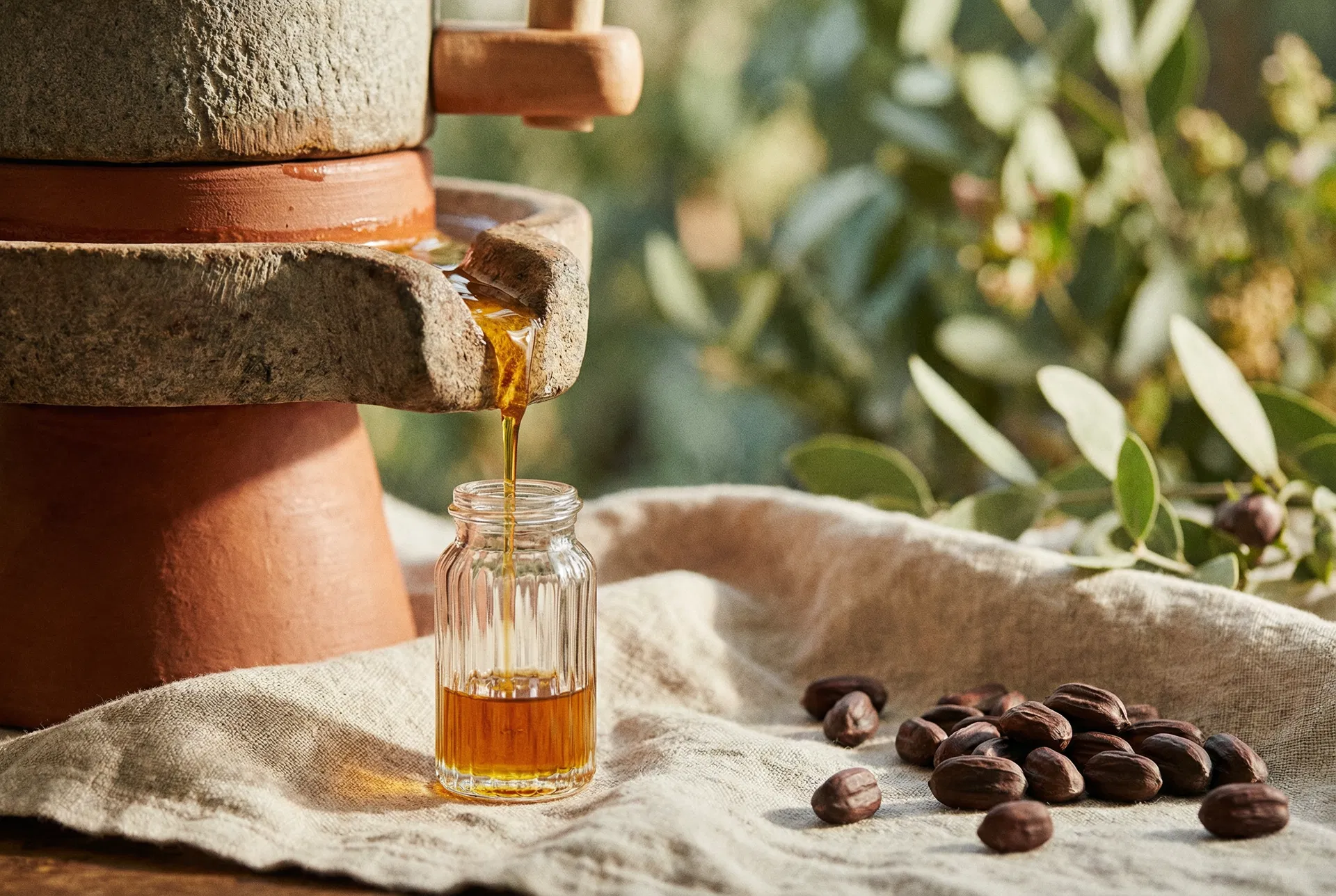
Cold-pressing is a mechanical extraction process. The dried seeds, nuts, or kernels are fed into a hydraulic or screw press, and the oil is extracted through physical pressure alone. No solvents. No heat beyond what is generated by the friction of the press itself — which is why temperature monitoring is critical. We work with pressing partners who maintain extraction temperatures below 45°C throughout the process.
The result is an oil that retains its full fatty acid profile, its natural colour, its scent, and its minor lipid components — the phospholipids, sterols, tocopherols, and carotenoids that are largely absent from refined equivalents. It is also, by definition, more variable. The colour of our rosehip oil changes slightly between harvests depending on the ripeness of the fruit and the growing conditions that season. That is not a quality control failure. That is what a real botanical ingredient looks like.
What to look for on a label
- "Cold-pressed" — the extraction method. Look for this alongside "unrefined" — cold-pressing alone does not prevent post-extraction refining.
- "Unrefined" — confirms the oil has not been bleached, deodorised, or otherwise processed after extraction.
- Colour — a refined oil will be pale and consistent. An unrefined oil will have a characteristic colour that varies between batches.
- Scent — refined oils are largely odourless. Unrefined oils have a distinct botanical scent. If it smells of nothing, it has been deodorised.
- INCI name — the Latin botanical name should be the only ingredient. If there are stabilisers, antioxidant additives, or carrier oils listed, the product is a blend.
The oils we press are not for everyone. They are darker than what most consumers expect. They smell like plants. They have a texture that varies with temperature. If you are looking for a pale, odourless, shelf-stable oil that behaves identically every time, there are plenty of options. We are not one of them.

