 Pressed by Nature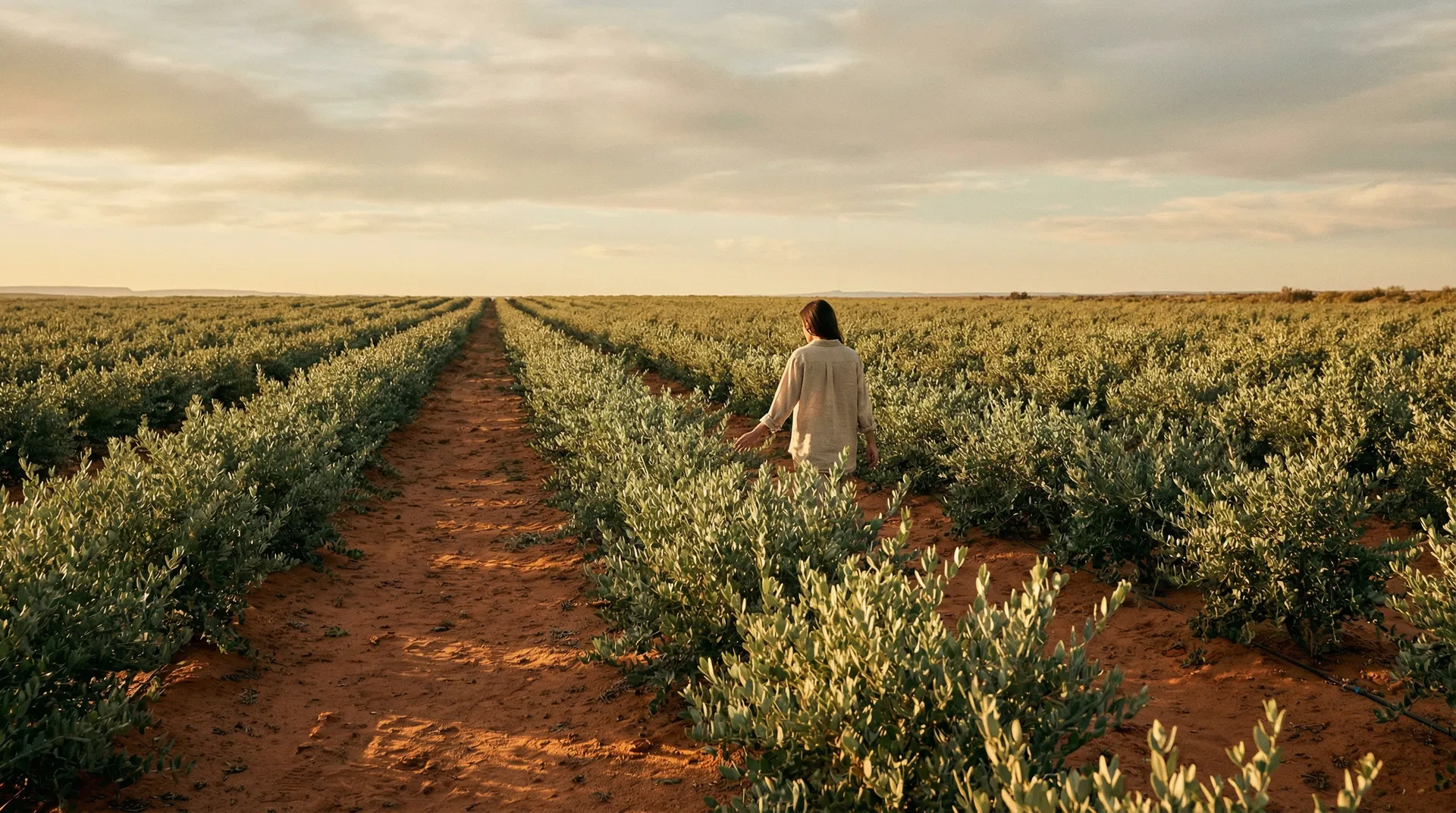
SOURCING & ETHICS
Where our oils
come from.
OUR SOURCING PHILOSOPHY
"We believe that the story of an oil begins in the soil, not in the bottle. The quality of what you apply to your skin is inseparable from the quality of the land it came from."
Every farm we work with has been visited, audited, and certified. We do not buy from commodity brokers or spot markets. We build long-term relationships with specific farms and cooperatives, pay fair prices, and publish what we know about each source.
OUR PRINCIPLES
Four commitments we
do not compromise on.
Regenerative Over Sustainable
Sustainability means doing less harm. Regenerative means actively restoring. We require our farm partners to demonstrate measurable improvements in soil health, biodiversity, and water retention over time.
Fair-Trade Labour
Every farm in our network pays above-market wages and provides safe working conditions. Where cooperatives exist, we pay directly to the cooperative — not through intermediaries.
Origin Transparency
We publish the country and region of origin for every product. We are working toward publishing the specific farm name and GPS coordinates for each product — this is our goal for 2025.
Cold-Pressed Only
We do not sell refined, bleached, or deodorised oils. If a botanical cannot be cold-pressed to a commercially viable quality, we do not stock it. The extraction method is as important as the certification.
FARM STORIES
The farms behind
every bottle.
FARM STORY
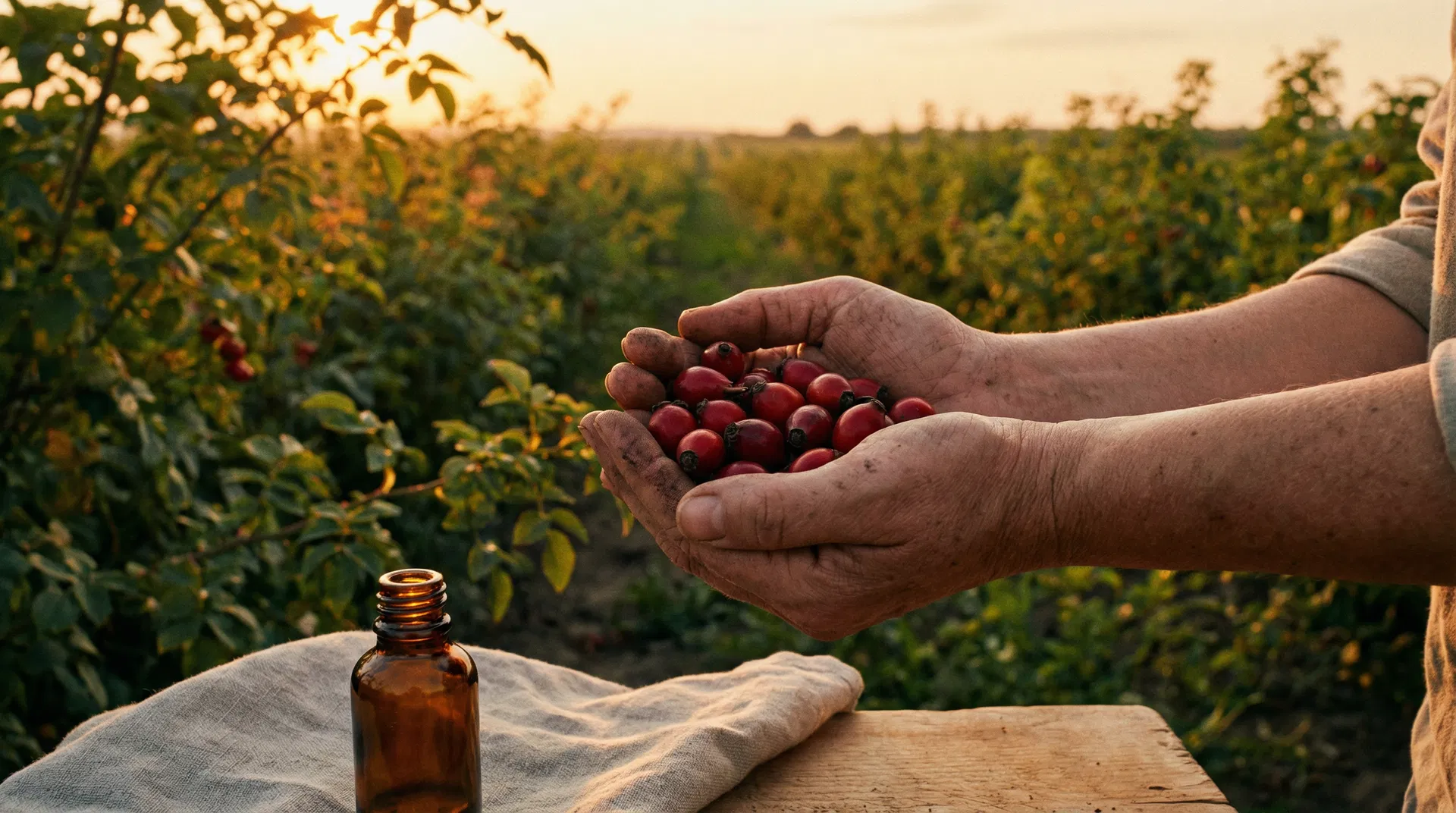
Rosa Canina — Chilean Andes
Wild-harvested rosehip at altitude
Wild Rosa canina grows at elevations between 1,200 and 2,400 metres in the valleys of the Chilean Andes. The cold climate and high UV exposure at altitude concentrate the plant's natural trans-retinoic acid content — the compound responsible for rosehip oil's extraordinary skin-regenerating properties.
Our partner in the Maule Region has been wild-harvesting rosehips for three generations. The harvest takes place each autumn (April–May in the Southern Hemisphere), when the berries reach peak ripeness. Harvesting is done entirely by hand — no machinery touches the plant.
Seeds are separated from the fruit pulp within 24 hours of harvest and cold-pressed within 48 hours. This rapid processing is critical: rosehip oil oxidises quickly, and the shorter the time between harvest and pressing, the higher the bioactive content of the finished oil.
PRACTICES
- —Wild-harvested — no cultivation, no land clearing
- —Hand-harvested by local community workers
- —Seeds cold-pressed within 48 hours of harvest
- —Zero synthetic inputs at any stage
- —Independently audited supply chain
FARM STORY
Simmondsia Chinensis — Sonoran Desert
Certified organic desert jojoba
The Sonoran Desert in Arizona is the natural home of Simmondsia chinensis — the jojoba shrub. A drought-tolerant perennial that lives for over 100 years, jojoba is one of the most sustainable botanical crops on earth. It requires no irrigation beyond natural rainfall, fixes nitrogen in the soil, and provides habitat for native desert species.
Our partner farm in Arizona has been farming without synthetic inputs since 1998. The jojoba shrubs are grown without any synthetic inputs, and the farm operates a closed-loop water management system that captures and recycles all runoff.
The beans are harvested mechanically in late summer, then cold-pressed in small batches at the farm's on-site processing facility. The golden colour of unrefined jojoba is the natural colour of the wax esters — if yours is colourless, it has been refined and deodorised.
PRACTICES
- —Drought-resistant perennial — minimal water use
- —Farming without synthetic inputs since 1998
- —Closed-loop water management system
- —Cold-pressed on-site within days of harvest
- —Farm supports native desert ecosystem
FARM STORY
Vitellaria Paradoxa — Northern Ghana
Fair-trade women's cooperative shea
The shea tree (Vitellaria paradoxa) is a wild-growing indigenous species of the West African savannah. It cannot be cultivated — it grows only in the wild, and takes 15–20 years to reach maturity. This means that every jar of shea butter you buy is the product of a wild ecosystem, not a plantation.
Our shea is sourced directly from a women's cooperative in the Upper West Region of Ghana, where shea processing has been a cornerstone of women's economic independence for centuries. The cooperative employs over 200 women, who hand-collect the fallen shea nuts, process them using traditional methods, and cold-press the butter in small batches.
We pay a fair-trade premium above market price, which funds the cooperative's community health and education programmes. The shea tree is never cut — it is protected by the communities that depend on it.
PRACTICES
- —Wild-harvested from indigenous shea trees
- —Processed by women's cooperative — fair-trade premium paid
- —Traditional cold-processing methods preserved
- —Shea trees protected — never cut
- —Community health and education programmes funded
THE COLD-PRESSING PROCESS
From seed to bottle —
without compromise.
Harvest
Seeds, nuts, or kernels are harvested at peak ripeness — by hand where possible, mechanically only where scale requires it. Timing is critical: the bioactive content of most botanicals peaks at a specific point in the ripening cycle.
Cleaning & Sorting
Raw material is cleaned of debris and sorted to remove damaged or immature specimens. No chemical washing agents are used — only water and mechanical sorting.
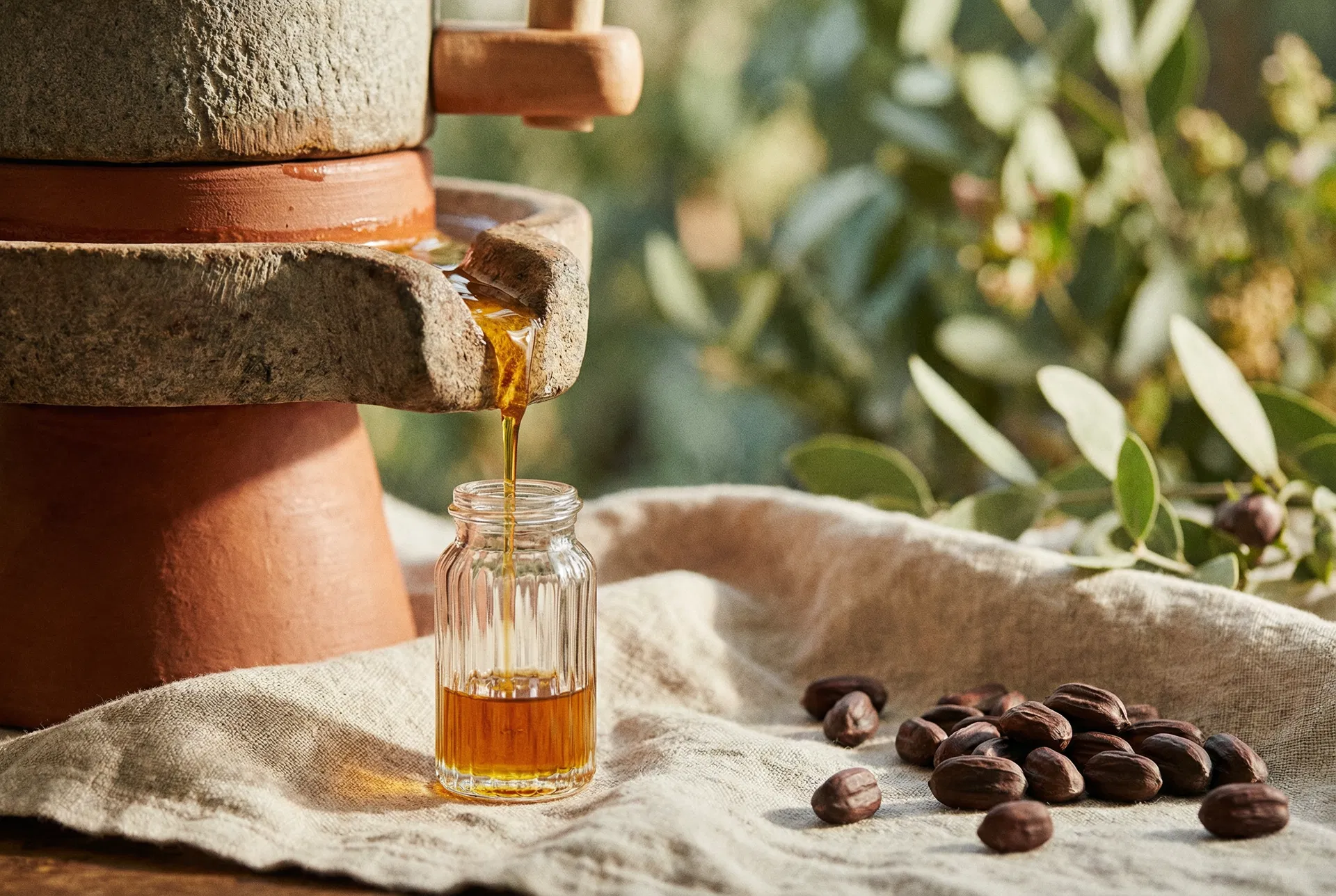
Cold-Pressing
Seeds are fed into a hydraulic or screw press. Mechanical pressure extracts the oil without heat. The temperature of the press is monitored continuously — we require it to remain below 49°C at all times. This preserves the complete fatty acid profile, natural colour, and all heat-sensitive bioactive compounds.
Settling & Filtering
The raw-pressed oil is allowed to settle by gravity for 24–72 hours. Fine plant particles sink to the bottom. We use only gravity settling and light mechanical filtration — no bleaching clays, no chemical deodorisation, no winterisation.
Testing
Each batch is tested for peroxide value (freshness), free fatty acid content (quality), and pesticide residues (certification compliance). Batches that fail any test are rejected entirely.
Packaging
Oil is filled into amber glass or matte aluminium containers under nitrogen gas to prevent oxidation. Labels are printed on recycled paper with water-based inks. No plastic at any stage.
Every bottle tells this story.
Shop our cold-pressed botanical range.